
Today marks Quake’s 25th anniversary, which also happens to coincide with my birthday. Coincidence? I think not!
Quake released on June 22, 1996. I was still in elementary school and I’m not entirely sure how I got my hands on it, probably through my cousin, but my dad and I were hooked and played nothing else for a good while.
Quake wasn’t just among the first fully 3D, real‑time‑rendered FPS games; it was executed so well that it still holds up today, that quality is what makes it unforgettable.
One area it doesn’t get enough recognition for (in my opinion) is its music and sound design. Even in a noisy, crowded place you would still make out the distinct wails of zombies, the metallic cling‑cling‑cling of grenades bouncing off walls, and the juicy splatter of gibs afterward. The CD also shipped with the atmospheric soundtrack by Nine Inch Nails. Which was, y’know, totally rad.
Quake’s development marks a hard time in id Software’s history. It was the last game co‑founder John Romero worked on at the studio. Creative differences with John Carmack strained their relationship, and Romero’s departure eventually led others, like Tom Hall, to move on as well. Luckily, all these guys are still around today and making cool stuff.
Something lesser‑known was QuakeEd, the level editor John Romero developed to author all 32 Quake levels. They were unusual in the industry for building tools on Steve Jobs’ NeXT computers (running NeXTSTEP, something like the early macOS).
Romero had originally written the DOOM editor (DoomEd) as well, and branched it for Quake. Replacing DOOM’s 2D sector approach with a 3D brush‑based level design that compiled into Carmack’s binary space partitioning (BSP) system, methods still popular today. One major upgrade over DoomEd was a 3D preview. Actual editing, though, still happened on front and side 2D grids.
Both DOOM and Quake’s level editors were written in Objective‑C on NeXTSTEP. They were a big part of id Software’s early success, but they made it hard to use the tools on other platforms.
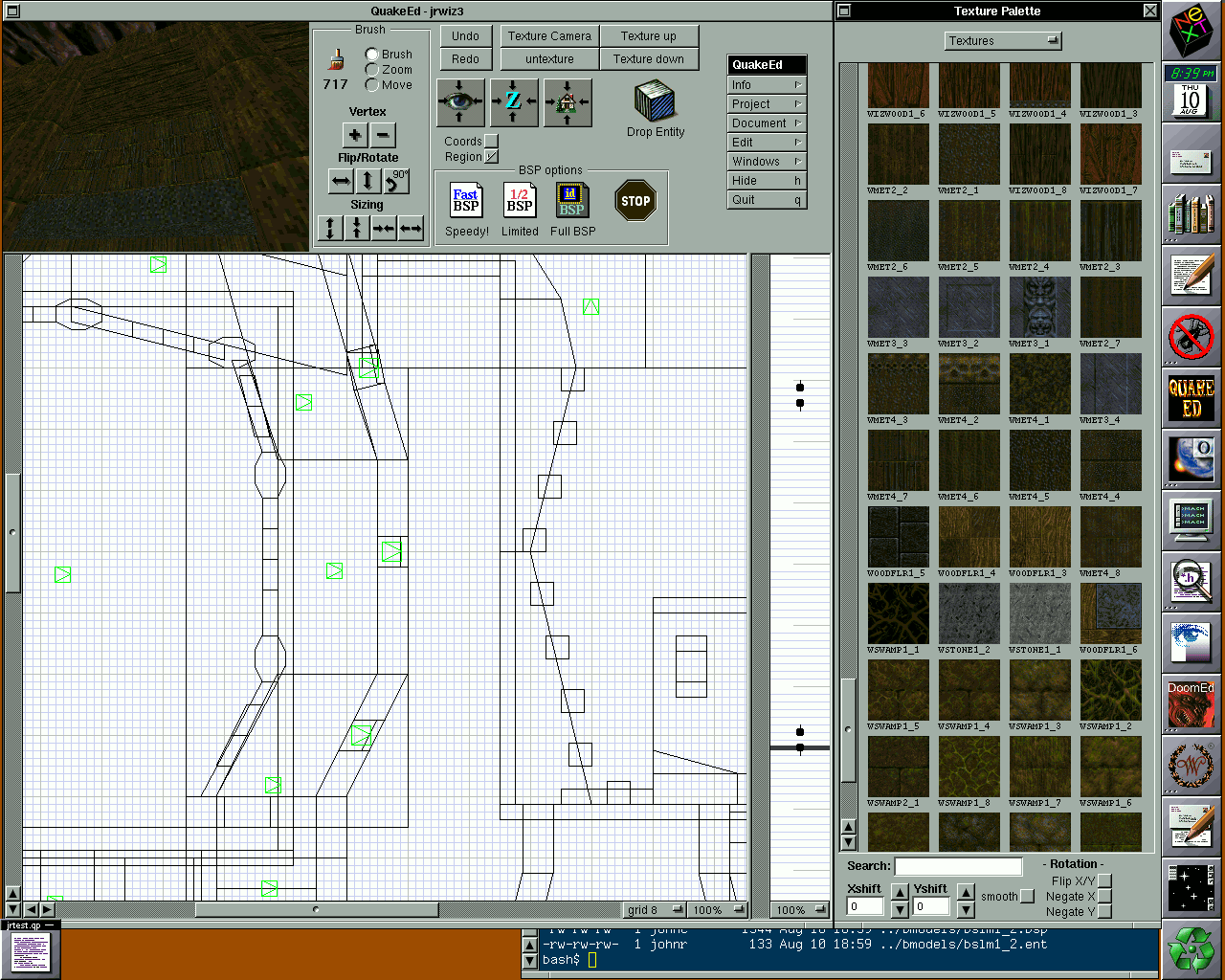 NeXTSTEP Operating System & QuakeEd, 1995
The complexity of building levels in 3D posed a problem, more depth meant more detail, and the Quake level file format being capped at 1.4 MB, each map had to stay relatively small. John Carmack decided they could get more gameplay out of the small environments if they slowed down the player’s running speed. In DOOM the player usually booked it, and with its huge sprawling levels that speed wasn’t a problem. To me, the slower pace of Quake worked well regardless.
There are so many interesting tidbits about id Software and DOOM/Quake’s development, which made “Masters of Doom” one of my favorite books. If you’re into that kinda thing, give it a read!